

Earlier this year the review editor of Christian Courier contacted me to see if I would be interested in reviewing a poetry book. I jumped at the chance!
Below is my review of You Are A Sacred Place, also currently online at Christian Courier.
You Are a Sacred Place – Visual Poems for Living in Climate Crisis
by Madeleine Jubilee Saito
The title of Madeleine Jubilee Saito’s book intrigued me. What, I wondered, are visual poems? And how would poetry be used to contribute to the climate discussion?
As I paged through the book the first time, I felt dismay. This wasn’t your usual book of wordy poems. In fact, there weren’t many words at all. How would I make sense of it? I decided to go through the volume slowly from beginning to end.
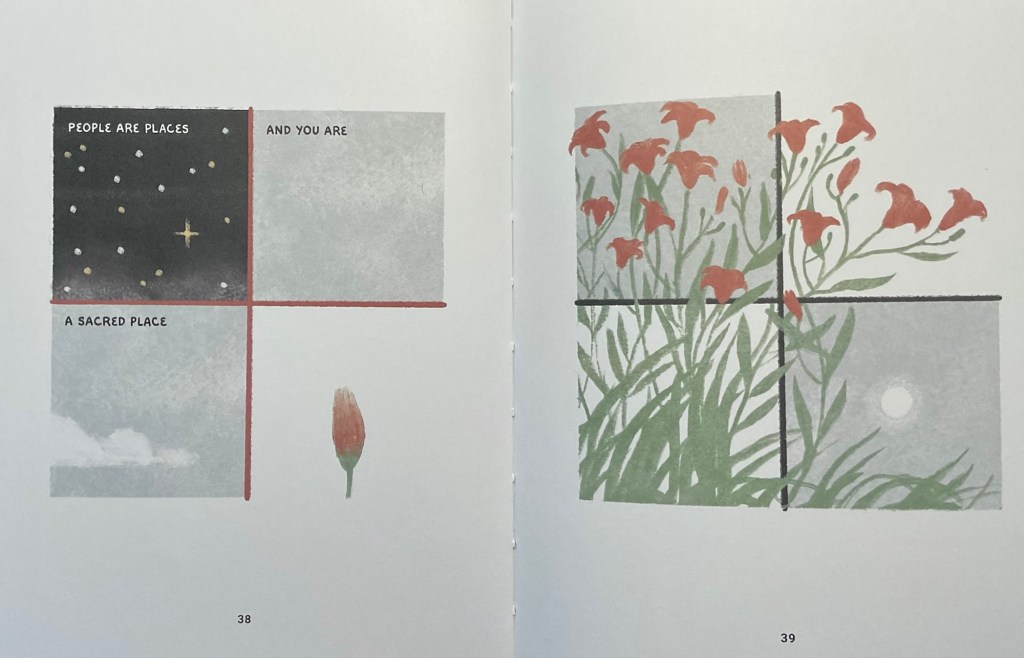
In this 192-page book of seventeen poems, poet Saito has created an integration of art and words. Square visuals, often divided into four smaller squares, dominate most pages. The graphics are simple and elegant in design and colour, and iconic in subject matter. Sometimes words are included within or just outside the boxed drawings but often not. As I read through the words and studied the images, a story emerged.
Poem One sets the scene: job loss, skies filled with wildfire smoke, bad air, red sun, an unusually long hot summer, depression: “you asked me if it / would be better / if you weren’t here/ anymore … you said / maybe it would / be better/ if you were gone” (pp. 6,9).
These sobering words are illustrated with images—panes of black, a red sun peeking through curtains, a candle glowing in the dark, and a girl’s head resting on a pillow, with wide open eyes. The last image of this poem is the bare pillow (was it intended to resemble a grave marker, I wondered).
Hooked by this moving scenario, I read on. Succeeding poems continue the bleak greyness, then expand into considering larger themes of us humans and the world, us humans in the world (“small… soft… watery”), and within community (illustrated by pinpoints of light against the darkness, like a city at night. Poem three concludes with the reassuring lines: “it is very good / that you are here” (p. 31).
A favourite of mine was poem four—a love poem illustrated with lilies and stars. It reminded me of the Song of Solomon.
However, Saito’s poems go beyond reflections on her personal situation. In poems five through eight her social justice outrage is palpable as she rails against society’s ills and what are commonly thought to be human causes of climate change. Words from poem seven: “splintering … sharp pains… centuries of rot … wounds on wounds / scars on scars” are accompanied by images of what look like multiplying viruses. Poem eight is a particularly pointed criticism, in words and images, of the fossil fuel industry.

’m glad the book doesn’t end in despair, however. In poems nine through seventeen the tone becomes more hopeful as Saito addresses themes of survival, mutual belonging, healing, mending, remaking, nourishing, and appreciating. Her images of trees, flocks of birds, and a round earth globe filled with greenery are especially beautiful.
And there is faith. For example, scenes from poem sixteen – a hand holding a match lighting a candle followed by more candlelit scenes are captioned by: “as for me lately / I have been trying / to hold on to / that taut thread / between past / and future … God will not leave us / God has not abandoned us / God is in love / with the world” (pp. 154, 158,9).
I found the interplay between words and graphics fascinating. Because many of the graphics are repeated (e.g. head on pillow, candle shining in darkness, starry night skies and night cityscapes), they became a kind of shorthand for me, signifying the passing of time, thoughts and prayers during sleepless night hours, hope in darkness, God’s presence even at night, and the comfort of being part of a community.
This hardbound book with its embossed cover of soft grey adorned with one of the book’s illustrations is an art object on its own.
I found the poems both inspirational and motivational. They drew my attention to our beautiful but fragile earth home and what we can do to preserve it, and us who live on it, with loving attention and stewardship.
***********
Book Facts:
Title: You Are a Sacred Place – Visual Poems for Living in Climate Crisis
Author: Madeleine Jubilee Saito
Publisher: Andrews McMeel Publishing
Date of Publication: – March 2025

 Violet Nesdoly