

Here we are already at the end of the second month of 2026! This month I’m sharing my review of D.S. Martin’s latest book of poems, The Role of the Moon.
Paraclete Press (the book’s publisher) has informed me that this book has just won the Gold Medal for Poetry in the 2026 Illumination Christian Book Awards. Congratulations, D.S. Martin!!
(This review was first published in the The Christian Courier – January, 2026.)
The Role of the Moon – review by V. Nesdoly
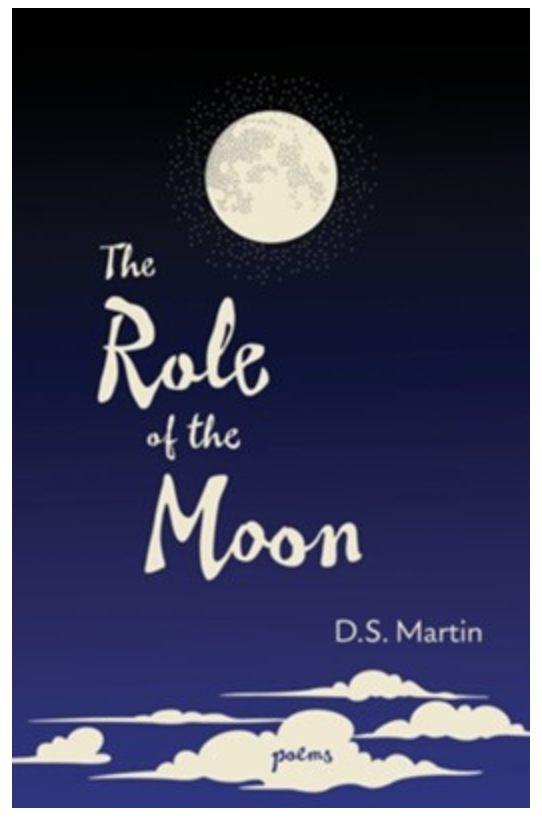
D.S. Martin’s latest book, The Role of the Moon, is a collection of 63 poems that will delight both the casual reader of poetry and the poetry nerd. Divided into seven numbered sections, the 128-page volume concludes with nineteen sonnets by John Donne. Where does one begin reviewing such a hefty offering? I decided to start with the title, The Role of the Moon. What is its role but to reflect? So, I will look through this collection of poems for D.S. Martin’s reflections.
“Garden (Metaphysicals I),” the first poem in Part One, introduces us to Martin’s love of creation and the natural world. The poem begins “The world is a garden fearfully made” (p. 12). Martin’s admiration for earth’s beauty and craftsmanship is echoed in poems like “Curved Beauty,” “Sparrow,” and “You Could Have Made.”
But “Garden” (poem one) goes on to remind us that this garden has been despoiled: “…once well-formed / though now decayed” (p. 12). The theme of earth defiled is echoed in poems like “Ruins” which reminds us how this world seems programmed to disintegrate and in “Molding of Man” where what is created fresh and perfect “… now cracks & crumbles / & grows dim” (p.53, 54). However, disintegration is not the end. In “Sympathy” Martin addresses the devil: “when you took the bait / & concocted death / you inadvertently opened in our / hearts a desire for what you’d stolen away” (p. 89).
Which brings us to the difference God makes to us and the fallen world. In “Weight (Metaphysicals XI)” Martin reminds us that God is up to carrying the weight of the world. We hear the invitation “come to the one who offers rest” in “The World’s Sharpness” (p. 83). We are offered cleansing in “Carwash (Metaphysicals IV). In poem sequences “Prayer” and “Litany” Martin explores many facets of the resultant relationship with God.
Martin’s honesty and humility in admitting his faults and shortcomings is moving. In “Water Tower (Metaphysicals III)” he rues wasted energy “over what has come to nothing” (p.14). In “Love Like an Ocean” he begs to have his ambivalence, apathy, and complacency pummelled by the storms of God’s mercy and goodness.
But the collection is also pervaded with a sense of hope and longing, especially for heaven. In “My Final Credits (Metaphysicals VI)” he views his life as the end-of-movie credits with the knowledge this is not the end: “as in anticipation I prepare / for the sequel” (p.35). He envisions his parents and grandparents’ activities in heaven in “Glorified (Metaphysicals VIII).” The poem “Glisten (Metaphysicals XVIII)” speaks of the wonderful future for the church, with this poignant ending: “She’s so slow to listen / it would be easy to / dismiss her // Show me / dear Christ your bride / flawless bright & clear / Let me see you kiss her” (p. 102).
A unique aspect of The Role of the Moon is Martin’s reflection of and on poets from the past. Poetry buffs will enjoy spotting phrases, lines, and themes of poems from the archives. Where poets are not named but lines sounded familiar, I searched for possible sources and found references to the works of Hopkins, Traherne, Blake, Donne, Dickinson, Herbert, and more.
A subset of Martin’s reflections on poetry past is his own offering of metaphysical poems. Martin defines metaphysical poets as “…those who use metaphors… to talk about ideas outside of human perception” (p. 9). He was especially impacted by the poetry of John Donne and explains: ”The nineteen poems identified as Metaphysicals in this collection are my interactions with Donne’s nineteen Holy Sonnets” (p. 9 ).
Finally, a few reflections of my own.
Most of the poems are short and composed in D.S. Martin’s recognizable style—no punctuation except question marks (an extra space between words, and line and stanza breaks provide reading clues), with the ampersand consistently designating “and.”
Not surprisingly, he uses poetic devices with thoughtfulness and skill. Note this pleasing alliteration in “Curved Beauty”: “Glory be to God for the dance of willows in the wind / the swerve & swoop of swallows in flight the arc / of a crescent moon the curve of a tusk the crook in a brook” (p. 18).
Martin uses rhyme with economy and effect. I loved the internal rhymes in “Poem Arising from a Line by Herbert”: “Will you someday permit the bird to fly / Lift to the sky an arrow from my hand? / Let what I’ve planned bring honour to your name / so I won’t blame myself for wasting hours” (p. 71).
I enjoyed the clever word play of “Cardinal Virtues” where Martin weaves the virtues of temperance, prudence, fortitude and justice into a poem about cardinals. In that poem he also adds a casual and amusing aside (about a fact he has stated): “I googled it” (p. 70). In another poem about an exotic frog he says: “you’re too late we’re extinct kaput” (“Chorus of the Splendid Poison Frog” p. 80). Such common expressions inserted into poems that are mostly formal make them fun to read. You don’t have to be a poetry scholar to enjoy Martin’s modern and accessible verses.
My paperback copy of The Role of the Moon, with its creamy white moon and lettering against a rich navy background is beautiful and feels comfortable, compact, but much too light to be the container of the poetic weight of this collection. It is an engaging and thought-provoking literary gift to the Christian community of the 21st century, and highly recommended.

 Violet Nesdoly